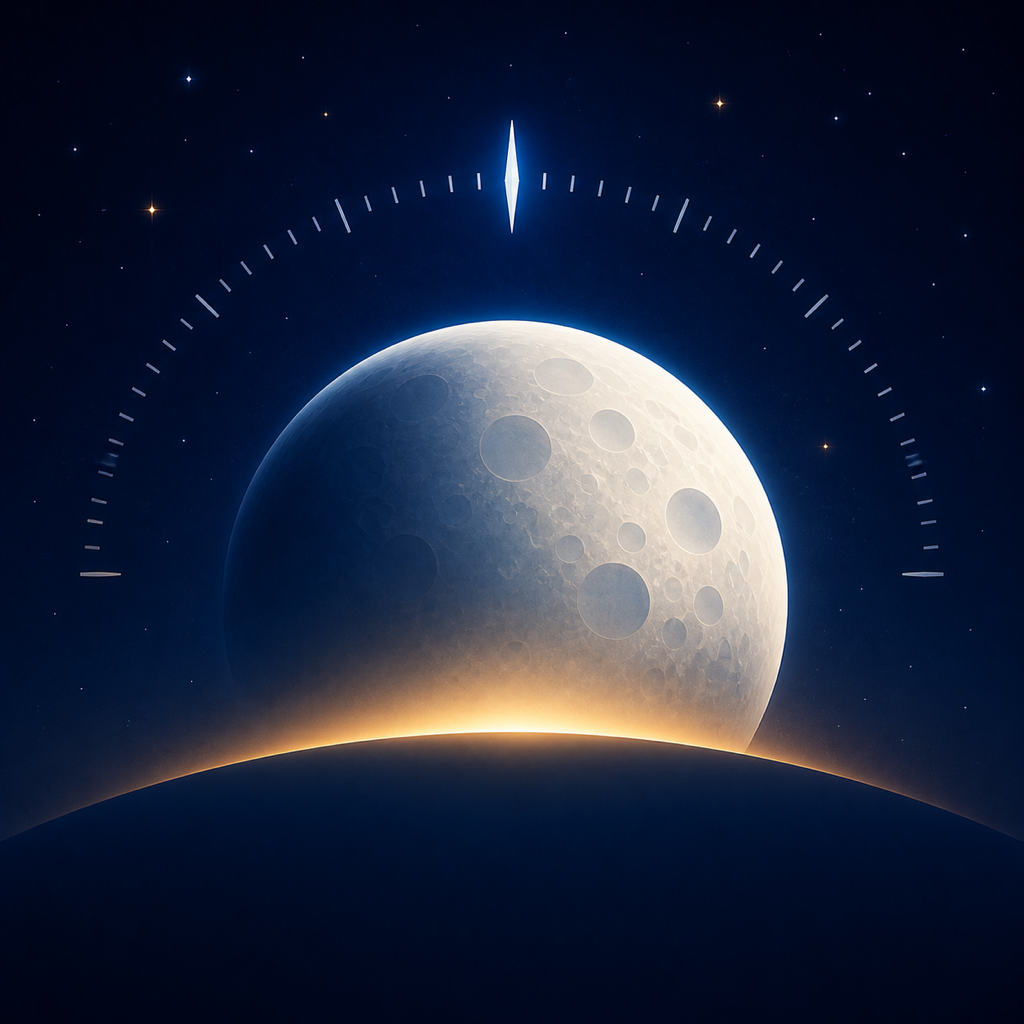
A Full Moon near perigee
The Moon’s orbit is elliptical rather than perfectly circular. Its distance from Earth changes continuously. The closest point in each orbit is called perigee, and the farthest is apogee. “Supermoon” is the popular term for a Full Moon that occurs near perigee.
It is not an official astronomical classification with one universally enforced boundary. A commonly used definition includes a Full Moon within 90 percent of its closest possible approach to Earth. Different calendars can therefore disagree about whether an edge case counts.
How different does it look?
NASA notes that a nearby perigee Full Moon can appear up to about 14 percent larger and 30 percent brighter than a Full Moon near apogee. That comparison is real, but it is difficult to judge from memory when the events are months apart. Most observers will not see a dramatically oversized disk simply by stepping outside.
The difference is easiest to demonstrate with photographs made using the same focal length and framing. Brightness may be more noticeable in a dark landscape, although haze, cloud, and local lighting can overwhelm it.
The best way to enjoy one
Plan for moonrise. A Full Moon rises near sunset, and the low Moon can be composed with familiar foreground objects. Atmospheric color and the Moon illusion often make this moment more visually dramatic than the modest physical size difference. Check the exact local rise time and direction; perigee itself can occur hours away from the Full Moon.