Altitude
ObservingThe angle of an object above the observer's horizon, measured from 0 degrees at the horizon to 90 degrees at the zenith.
See definition and visualRead the full guide Moonrise Moment
Moon glossary
From azimuth to waxing, find clear definitions and visuals for the language used to describe the Moon.
Showing all 72 terms
Try a broader word such as phase, orbit, eclipse, or surface.
The angle of an object above the observer's horizon, measured from 0 degrees at the horizon to 90 degrees at the zenith.
See definition and visualRead the full guideThe point in the Moon's orbit where it is farthest from Earth.
See definition and visualRead the full guideA compass direction measured clockwise around the horizon, usually from 0 degrees at north through 90 degrees at east.
See definition and visualRead the full guideA popular name for the reddish Moon seen during a total lunar eclipse, when sunlight filtered through Earth's atmosphere reaches the lunar surface.
See definition and visualRead the full guideA calendar nickname for an extra full Moon. It commonly means the second full Moon in one calendar month, though a seasonal definition also exists.
See definition and visualRead the full guideA phase in which less than half of the Moon's visible disk is illuminated. A crescent may be waxing or waning.
See definition and visualRead the full guideThe moment a celestial object crosses the observer's meridian and usually reaches its highest altitude for that passage.
See definition and visualAn informal and misleading phrase often used for the lunar far side. Both the near side and far side receive sunlight over a lunar month.
See definition and visualRead the full guideA celestial coordinate comparable to latitude on Earth. It measures angular distance north or south of the celestial equator.
See definition and visualThe faint glow on the Moon's unlit portion caused by sunlight reflecting from Earth to the Moon and back toward the observer.
See definition and visualRead the full guideAn event in which one celestial body moves into another body's shadow or blocks the observer's view of another body.
See definition and visualA measure of how much of an eclipsed body's diameter is covered by a shadow at a specified time, commonly at greatest eclipse.
See definition and visualA period of several weeks when the Sun is close enough to a lunar node for solar or lunar eclipses to occur.
See definition and visualThe Sun's apparent yearly path across Earth's sky. The Moon and planets remain near this path because their orbits have relatively small tilts.
See definition and visualEither of two yearly moments when the Sun crosses Earth's celestial equator and day and night are roughly equal in length.
See definition and visualThe lunar hemisphere that faces away from Earth most of the time. It is not permanently dark.
See definition and visualRead the full guideThe phase near one quarter of the way through the lunar cycle, when half of the Moon's visible disk appears illuminated and the lit portion is growing.
See definition and visualRead the full guideThe phase when the Moon is opposite the Sun in Earth's sky and its Earth-facing hemisphere appears almost completely illuminated.
See definition and visualRead the full guideA phase in which more than half, but not all, of the Moon's visible disk is illuminated. A gibbous Moon may be waxing or waning.
See definition and visualRead the full guideThe instant when the alignment of an eclipse is at its maximum, such as when the Moon passes closest to the axis of Earth's shadow during a lunar eclipse.
See definition and visualThe traditional name for the full Moon nearest the Northern Hemisphere's September equinox.
See definition and visualRead the full guideThe apparent boundary where sky meets land or sea. Local terrain and buildings can create a practical horizon above the astronomical horizon.
See definition and visualRead the full guideThe traditional name for the full Moon that follows the Harvest Moon.
See definition and visualRead the full guideThe fraction of the Moon's visible disk that appears lit by direct sunlight, commonly expressed as a percentage.
See definition and visualRead the full guideA very large impact depression. Many lunar basins were later flooded by basaltic lava and became maria.
See definition and visualA depression formed when an asteroid, meteoroid, or comet strikes the Moon's surface.
See definition and visualThe Moon's apparent nodding and rolling motion, which lets observers on Earth see slightly more than half of its surface over time.
See definition and visualThe apparent outer edge of the Moon's disk as seen by an observer.
See definition and visualThe interval from one local lunar noon to the next, lasting about 29.5 Earth days because the Moon rotates while orbiting Earth.
See definition and visualRead the full guideAn eclipse that occurs when the full Moon passes through some part of Earth's shadow.
See definition and visualRead the full guideThe Moon's bright, elevated, heavily cratered terrain. The highlands are generally older than the darker maria.
See definition and visualA general term for a cycle based on the Moon. Its exact length depends on the reference point, such as phase, stars, or orbital apsides.
See definition and visualEither point where the Moon's tilted orbit crosses the ecliptic. Eclipses require the Moon to be near a node.
See definition and visualThe changing apparent shape of the Moon's sunlit portion as the Moon moves around Earth.
Also called: Moon phase
See definition and visualRead the full guideA dark plain of ancient basaltic lava on the Moon. Mare is singular; maria is plural.
Also called: Lunar sea, Maria
See definition and visualAn imaginary great circle passing through the north point, zenith, and south point of an observer's sky.
Also called: Meridian passing, Upper transit, Culmination
See definition and visualAn informal name for a full or new Moon occurring near apogee, when the Moon is relatively far from Earth and appears slightly smaller.
See definition and visualRead the full guideThe perception that the Moon looks larger near the horizon than when it is high in the sky, even though its angular size changes very little.
See definition and visualRead the full guideThe moment the Moon's upper edge appears above the observer's horizon, with standard calculations accounting for atmospheric refraction.
See definition and visualRead the full guideThe moment the Moon's upper edge disappears below the observer's horizon, with standard calculations accounting for atmospheric refraction.
See definition and visualRead the full guideThe lunar hemisphere that faces Earth most of the time because the Moon rotates synchronously with its orbit.
See definition and visualThe phase when the Moon is near the Sun in Earth's sky and its illuminated hemisphere faces mostly away from Earth.
See definition and visualRead the full guideAn event in which a nearer celestial body passes in front of and hides a more distant object.
See definition and visualAn alignment in which an object appears opposite the Sun in Earth's sky. A full Moon occurs near lunar opposition.
See definition and visualThe tilt of an orbit relative to a reference plane. The Moon's orbit is tilted to the ecliptic, which is why eclipses do not happen every month.
See definition and visualA lunar eclipse in which part, but not all, of the Moon enters Earth's umbra.
See definition and visualRead the full guideThe lighter outer part of a shadow where the light source is only partially blocked.
See definition and visualA lunar eclipse in which the Moon passes through Earth's penumbra but does not enter the umbra.
See definition and visualRead the full guideThe point in the Moon's orbit where it is closest to Earth.
See definition and visualRead the full guideThe angle between the Sun and observer as seen from the Moon. It determines how much of the visible lunar disk is illuminated.
See definition and visualBright streaks of material thrown outward from a relatively young impact crater.
See definition and visualThe bending of light through Earth's atmosphere, which makes objects near the horizon appear slightly higher than their geometric positions.
See definition and visualThe loose layer of dust, broken rock, glass, and debris covering much of the Moon's solid bedrock.
Also called: Lunar soil
See definition and visualA celestial coordinate comparable to longitude on Earth, measured eastward along the celestial equator.
See definition and visualA long, narrow channel or crack on the lunar surface, often formed by ancient volcanism or crustal fracturing.
See definition and visualA period of about 18 years and 11 days after which eclipses with similar geometry recur.
See definition and visualThe roughly 27.3-day interval the Moon takes to complete one orbit relative to the background stars.
See definition and visualAn eclipse that occurs when the Moon passes between the Sun and Earth and casts its shadow on Earth.
See definition and visualRead the full guideA tide with a larger-than-average range that occurs near new and full Moon, when the Sun, Earth, and Moon are nearly aligned.
See definition and visualA traditional name commonly used in North America for the full Moon in June. The name does not describe the Moon's color.
See definition and visualRead the full guideAn informal name for a full or new Moon occurring near perigee, when the Moon appears somewhat larger than average.
See definition and visualRead the full guideRotation in which a body's spin period matches its orbital period, causing the same hemisphere to face the object it orbits.
Also called: Tidal locking
See definition and visualRead the full guideThe roughly 29.5-day interval from one occurrence of a lunar phase to the next occurrence of the same phase.
See definition and visualThe moving boundary between daylight and darkness on the Moon. Low-angle light near it makes surface relief easier to see.
See definition and visualThe long-term gravitational process that synchronized the Moon's rotation with its orbit, leaving nearly the same side facing Earth.
See definition and visualRead the full guideA lunar eclipse in which the entire Moon passes inside Earth's umbra, often giving the Moon a copper or red appearance.
See definition and visualRead the full guideThe interval during a total eclipse when the eclipsed disk is completely within the relevant shadow or completely covers the light source.
See definition and visualA passage across a reference line or another body's disk. In daily observing, meridian transit means crossing the local meridian.
See definition and visualThe darkest central part of a shadow, where the light source is completely blocked.
See definition and visualThe part of the lunar cycle when the illuminated fraction visible from Earth is decreasing.
See definition and visualRead the full guideThe part of the lunar cycle when the illuminated fraction visible from Earth is increasing.
See definition and visualRead the full guideThe point in the sky directly above an observer, corresponding to an altitude of 90 degrees.
See definition and visualDefinitions are written in plain language using NASA science and education references.
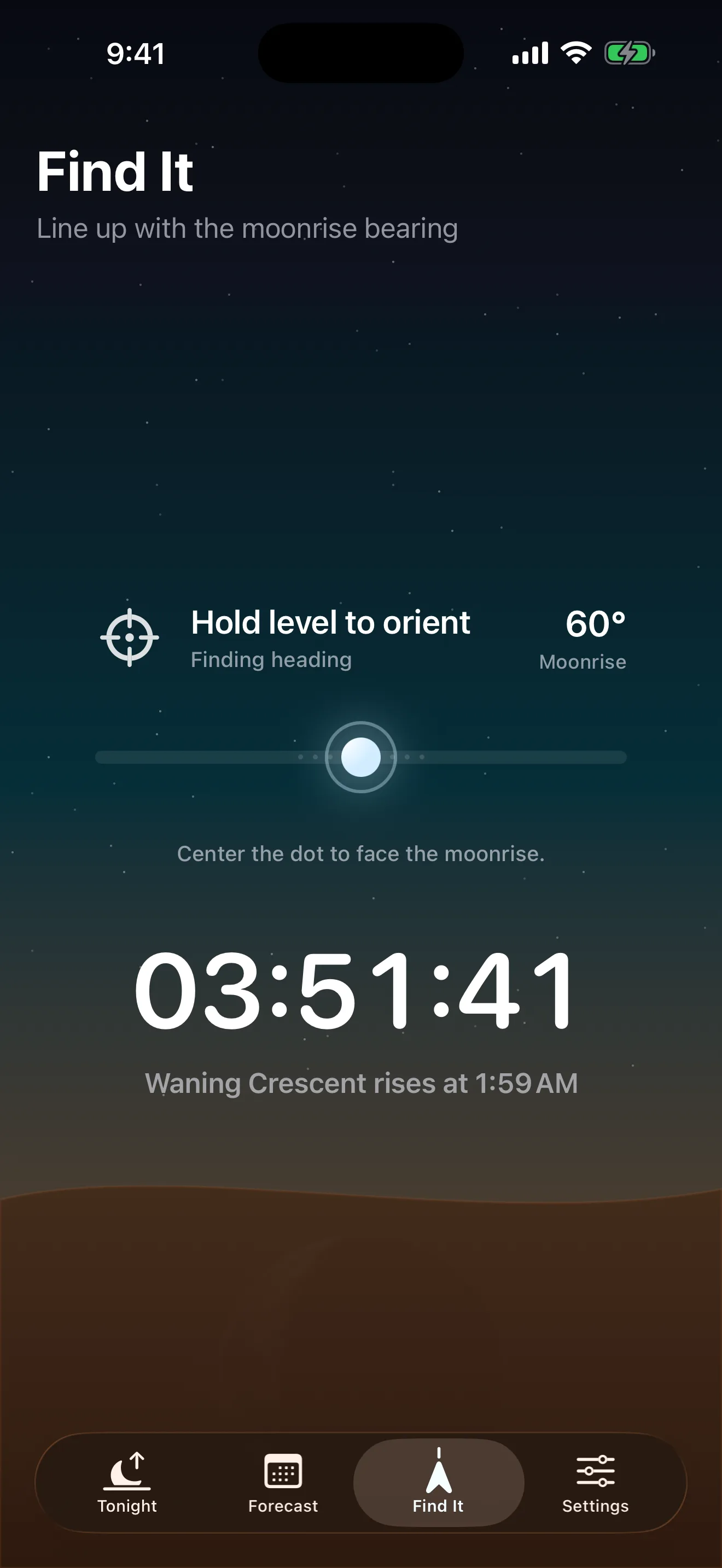
See when the Moon rises, which direction to face, and what will be visible from your location.