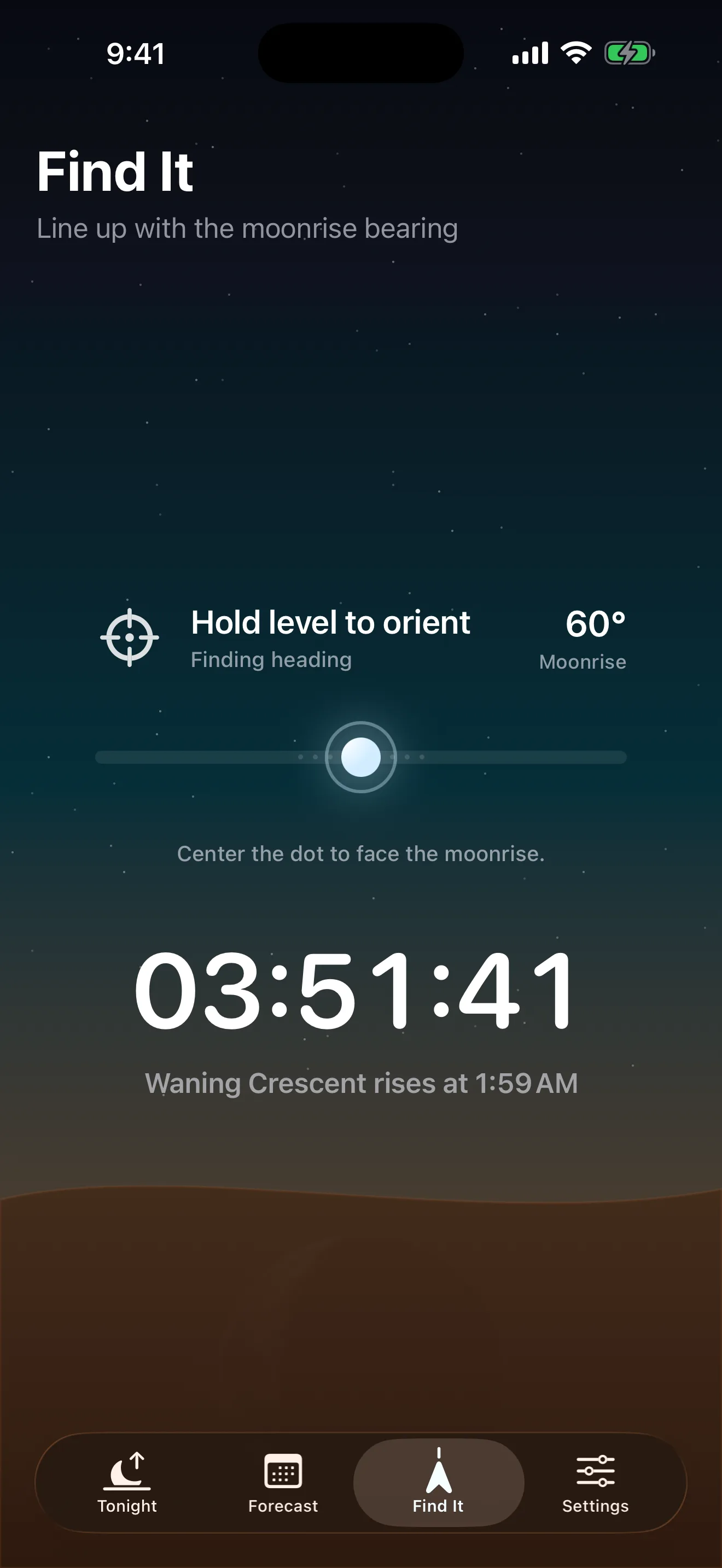
East is only the starting idea
For many observers, the Moon rises somewhere in the eastern half of the sky and sets somewhere in the western half. But “east” is a broad hint, not a precise instruction. The Moon can rise northeast, east, or southeast depending on its path for the day.
Declination moves the rise point
Declination is the Moon’s angular position north or south of the celestial equator. A more northerly Moon tends to rise farther north of east for many mid-latitude observers. A more southerly Moon tends to rise farther south of east.
The Moon’s orbit is tilted about 5 degrees relative to Earth’s orbit around the Sun, and the line of that tilt slowly changes over an 18.6 year cycle. That makes lunar rise points more complex than the Sun’s seasonal pattern.
Why direction matters more than a compass label
If a ridge blocks the southeast but the northeast is open, a 30 degree direction difference can decide whether moonrise is visible at all. For photography, the direction also decides what foreground the Moon will rise behind.