Start with place, not the clock
Moonrise tonight can change across a region because the observer is part of the geometry. Latitude, longitude, elevation, and the local horizon all matter. A forecast for a nearby city is often good enough for planning, but a precise viewing moment needs your actual position.
Check the phase before you go
The phase tells you what kind of moonrise you are trying to see. A full Moon usually rises near sunset and is often the easiest to watch. A thin crescent may rise in daylight or near twilight and can be much harder to notice. A last quarter Moon often rises around midnight, which makes it a very different outing.
Look at the eastern horizon
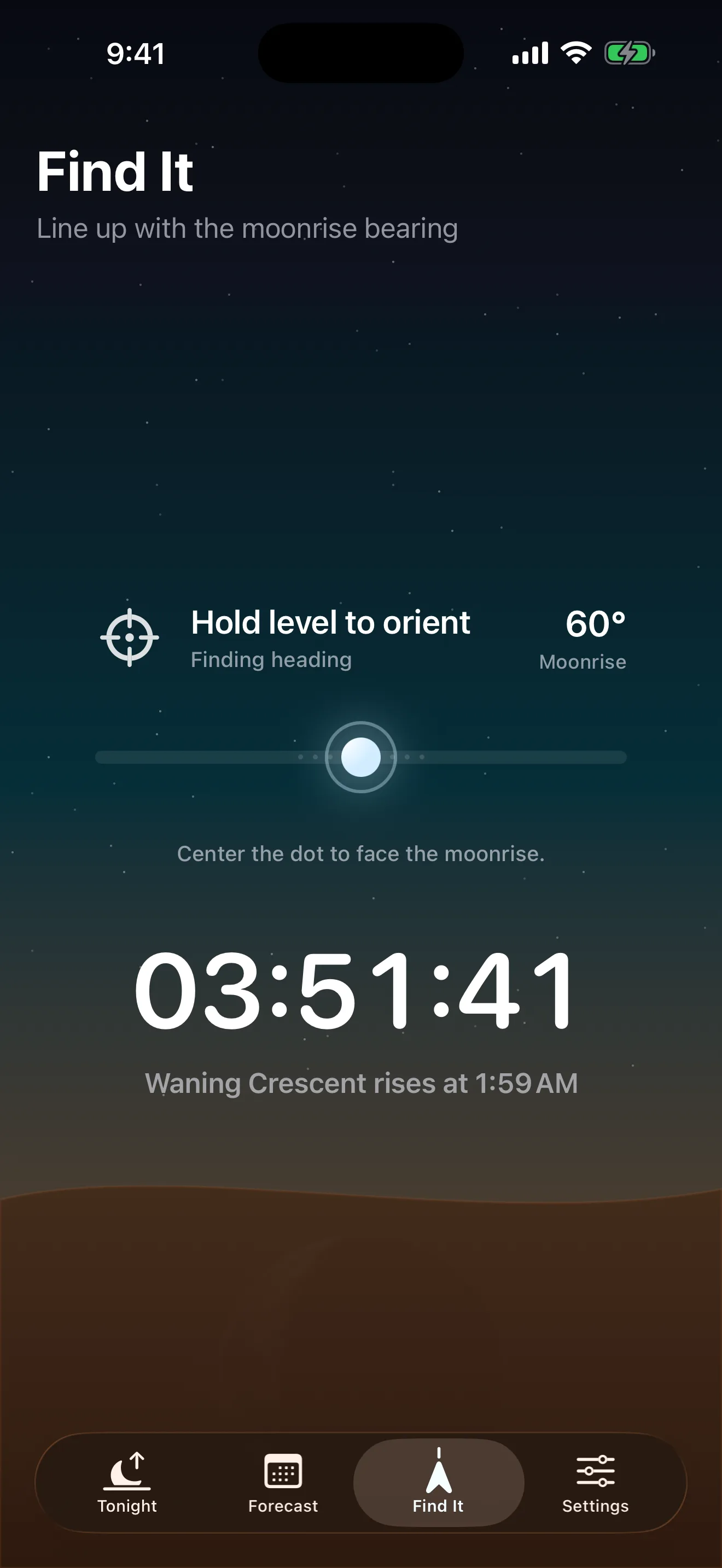
Most moonrises happen somewhere in the eastern half of the sky, but the exact direction can swing north or south of east. If buildings or hills block that part of the horizon, the visible Moon may appear later than the calculated time.
A practical checklist
- Use a location-specific moonrise time.
- Find the expected moonrise direction before leaving.
- Check whether the phase will be bright enough to see in your conditions.
- Arrive 10 to 20 minutes early if you want the first visible edge.
- Choose a place with an open horizon in the moonrise direction.
- Check low cloud, haze, and smoke, because the horizon is where the atmosphere is thickest.