The Moonrise journal
Learn one Moon thing today.
Fresh, sourced reading about the Moon, published every morning and evening.
Latest from the Moon.
Is the Moon a Planet?
The Moon is Earth's natural satellite, not a planet. Its classification follows what it orbits, not simply its size or shape.
Chang'e and the Moon
Meet Chang'e through early Chinese texts, later retellings, Mid-Autumn traditions, and the many meanings attached to her journey to the Moon.
How Weather Changes Moon Visibility
Cloud layers, haze, smoke, humidity, and atmospheric turbulence change the Moon's visibility, color, sharpness, and apparent rise.
Plan a moonrise
Moonrise after sunsetUse the phase to estimate whether the Moon rises near sunset, overnight, or in daylight.Moonrise weather and visibilityHow low cloud, haze, smoke, and twilight change the first visible moment.How to photograph moonrisePlan the bearing, foreground, lens, exposure, and timing before the Moon clears the horizon.Moonrise tonightWhy tonight's answer depends on your location, horizon, and the phase of the Moon.Best time to watchPhase, foreground, weather, and arrival timing for seeing the Moon clear the horizon.
Understand the motion
Moonrise Over Mountains and BuildingsCalculated moonrise uses an ideal horizon. Mountains, buildings, trees, and Earth curvature determine when the Moon first becomes visible to you.Planning a Moonrise PhotoPlan a Moon alignment by combining local rise time, azimuth, altitude, foreground distance, weather, and a daylight scouting visit.Best Phone Settings for Moon PhotosPhotograph the Moon with a phone by reducing exposure, locking focus, stabilizing the camera, and avoiding excessive digital zoom.Moon Viewing With BinocularsOrdinary binoculars reveal craters, maria, mountain shadows, and earthshine. Learn when to look and how to hold a steady view.Why We Always See the Same Side of the MoonThe Moon rotates once during each orbit around Earth. This synchronous rotation keeps the same hemisphere generally facing us.Dark Side vs. Far Side of the MoonThe Moon's far side is the hemisphere facing away from Earth. It receives sunlight just like the near side and is not permanently dark.Earthshine on the Crescent MoonEarthshine is sunlight reflected from Earth onto the Moon's night side, revealing a ghostly full disk inside a bright crescent.How Long Is a Lunar Day?One sunrise-to-sunrise day on the Moon lasts about 29.5 Earth days, creating roughly two weeks of daylight and two weeks of night.Does the Moon Rise in the East?The Moon generally rises on the eastern side of the horizon, but its exact bearing moves north and south through a wide seasonal cycle.Why the Moon Rises Later Each DayThe Moon moves eastward in orbit while Earth rotates, so Earth must turn farther before the Moon returns to the horizon. The delay is not constant.Can You See the Moon During the Day?The Moon is often above the horizon in daylight and bright enough to see. Phase determines when and where to look relative to the Sun.Why the Moon Looks OrangeA low Moon looks orange because its light travels through more atmosphere, which scatters shorter blue wavelengths out of the direct path.Why the Moon Looks Bigger at the HorizonThe horizon Moon is not substantially magnified by the atmosphere. The Moon illusion is a powerful effect created by visual context.Perigee vs apogeeHow the Moon's nearest and farthest orbital points affect apparent size, eclipses, and tides.Moon Names by MonthMonthly Full Moon names are cultural and seasonal labels, not astronomical types. Learn how to use them accurately and respectfully.What Is a Waxing Moon?A waxing Moon looks more illuminated each night. Learn which phases are waxing, how to spot them, and when they tend to appear in the sky.Strawberry Moon ExplainedThe Strawberry Moon is a traditional name for June's Full Moon. The name refers to season, not a pink lunar color.Hunter's Moon ExplainedThe Hunter's Moon is the Full Moon after the Harvest Moon. Its name is cultural; its local rise time still follows lunar geometry.Harvest Moon ExplainedThe Harvest Moon is the Full Moon closest to the September equinox. Its sequence of early-evening moonrises is shaped by seasonal geometry.What Is a Blue Moon?A blue moon is a calendar label for an extra Full Moon, not a change in lunar color. Learn the monthly and seasonal definitions.What Is a Micromoon?A micromoon is a Full Moon near apogee, the farthest portion of the Moon's orbit. Learn how its apparent size compares with a supermoon.Supermoon vs. Full MoonEvery supermoon is a Full Moon, but only Full Moons near perigee earn the popular label. Compare size, brightness, tides, and appearance.What Is a Supermoon?A supermoon is a Full Moon near perigee, the closest part of its orbit. Learn what the term means and what observers can actually notice.Lunar Eclipse PhotographyPhotograph a lunar eclipse by planning its altitude, stabilizing the camera, focusing manually, and changing exposure as the Moon darkens.How to Watch a Lunar EclipsePlan a lunar eclipse with local contact times, horizon visibility, weather, a dark observing spot, and simple equipment.Penumbral Lunar EclipsesA penumbral lunar eclipse softly dims the Full Moon as it crosses Earth's outer shadow. Learn why these eclipses can be difficult to see.Partial Lunar EclipsesA partial lunar eclipse occurs when only part of the Moon enters Earth's dark umbral shadow. Learn what it looks like and how to observe it.Why Does the Moon Turn Red?Earth's atmosphere turns an eclipsed Moon red by scattering blue light and bending red light into the planet's shadow.Solar eclipse vs lunar eclipseHow the alignment, viewing area, duration, and safety rules differ.What Is a Blood Moon?A blood moon is a total lunar eclipse. Learn why the Moon turns red, how long the color lasts, and when it is safe to watch.Why the Moon rises about 50 minutes laterThe orbital reason moonrise averages about 50 minutes later each day.How moonrise time and direction workHow astronomy and your horizon determine when and where the Moon appears.The 8 Moon phasesThe eight phases in order, what their names mean, and roughly when each one rises.Full moonriseWhy full moons rise near sunset and why that makes them so visually dramatic.Moonrise directionThe Moon rises in the eastern half of the sky, but not always due east.Terrain and altitudeHow hills, ridges, buildings, and observer height move the visible rise moment.Why moonrise changesThe orbital reason moonrise usually slides later from night to night.The Moon illusionWhy the Moon can look enormous near the horizon even when its angular size barely changes.Moonrise vs moonsetSame sky mechanics, opposite horizon event. Here is how to tell them apart.
Lost in lunar language?
Look up 72 terms for Moon phases, eclipses, orbit, observation, and geology.
Want the exact moonrise from where you are?
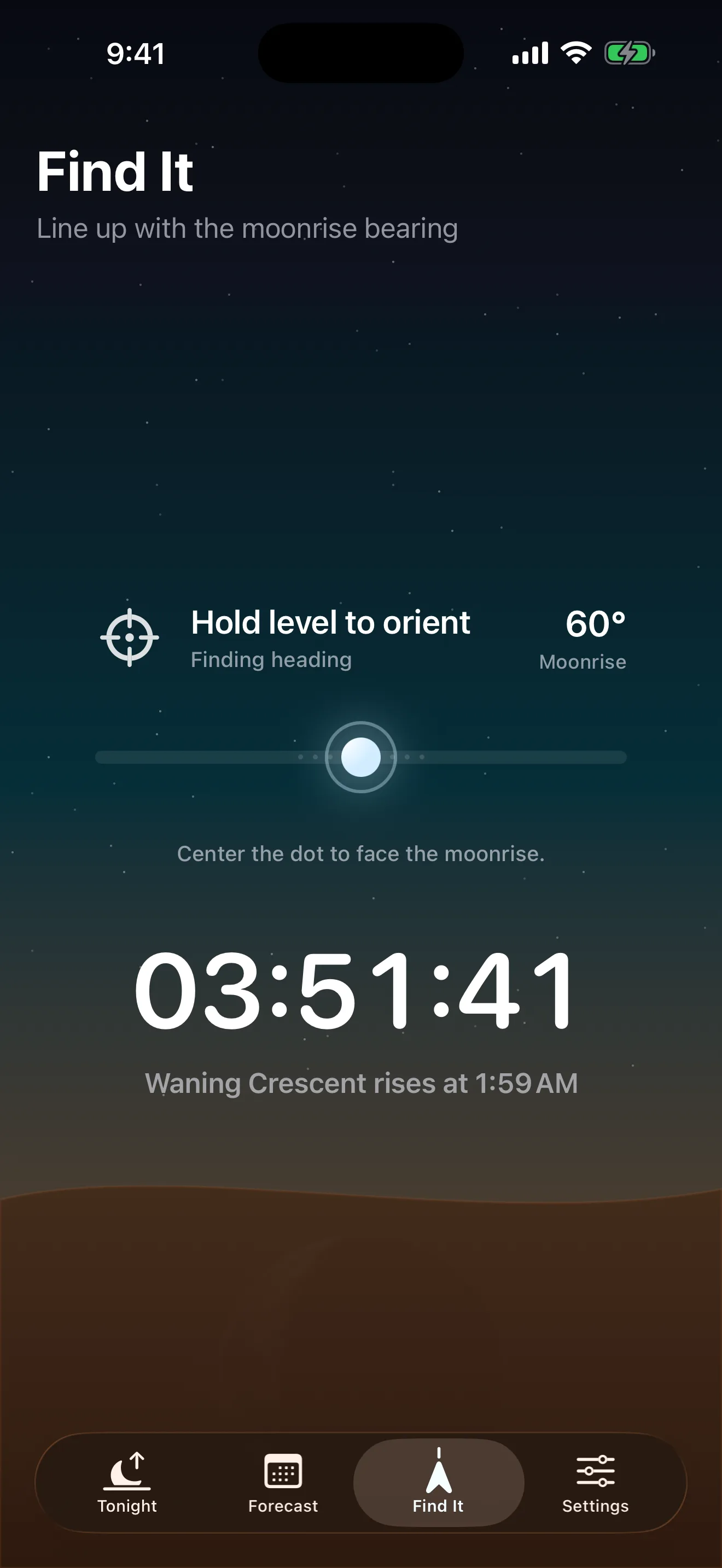
Moonrise Moment turns the science into a local countdown, phase preview, altitude note, and direction guide.