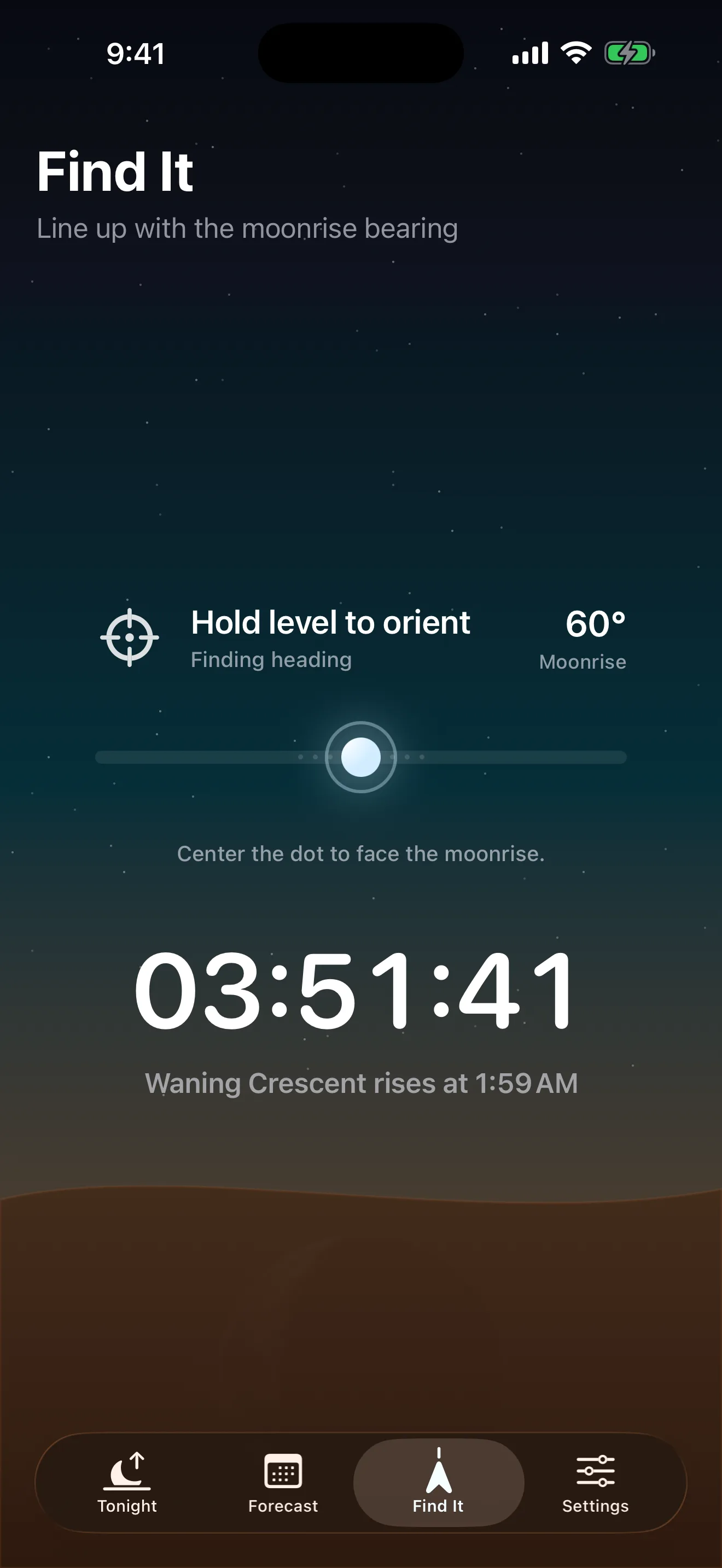
Begin with geometry
Choose the foreground first: a ridge, tower, bridge, tree, or skyline. Record the intended camera position and the landmark’s bearing. Then find a date when moonrise azimuth approaches that line.
The published rise time describes the geometric horizon. A foreground above zero degrees elevation means the Moon must climb before appearing. Estimate the landmark’s angular height or scout with an augmented-reality view, then check when the Moon reaches that altitude.
Distance controls apparent scale
The Moon’s angular size is almost fixed for a given night. To make it look large relative to a landmark, move farther from the landmark and use a longer focal length. Distance makes the foreground occupy a smaller angle while the Moon remains nearly unchanged, allowing the two to match in scale.
Scout and keep alternatives
Visit during daylight to confirm access, footing, sight lines, and obstructions. Mark more than one camera position because a few degrees of azimuth error can ruin a tight alignment. Check cloud cover, haze, smoke, and wind, not merely precipitation.
Arrive early. Twilight changes quickly, and the Moon may become visible later than calculated behind terrain or atmospheric haze. Capture wider safety frames before switching to a long lens. If cloud wins, retain the plan: similar lunar geometry often returns on nearby dates or in a later monthly cycle.