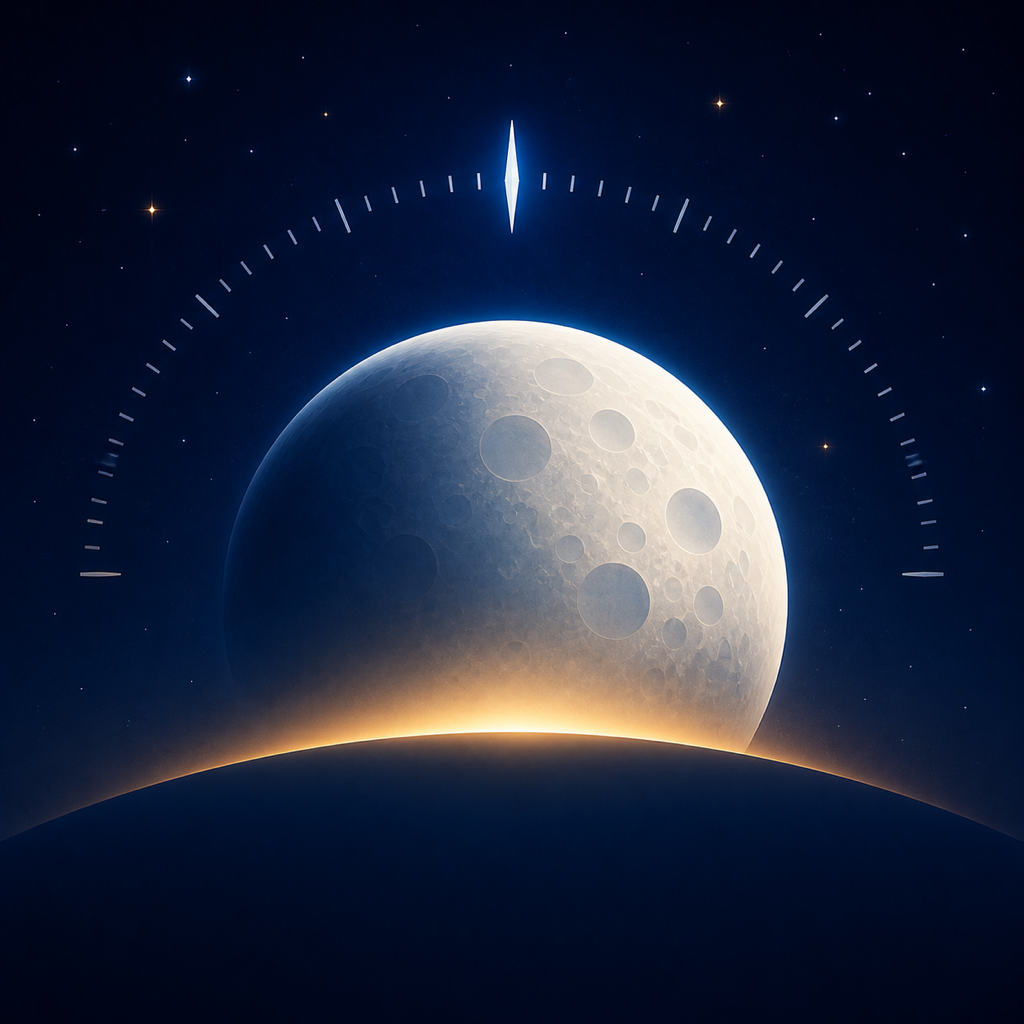
A distant Full Moon
“Micromoon” is an informal counterpart to “supermoon.” It refers to a Full Moon occurring near apogee, the farthest part of the Moon’s elliptical orbit around Earth. The Moon’s physical diameter has not changed; its greater distance makes its angular diameter slightly smaller in our sky.
Like supermoon, micromoon is not an official classification with a universally fixed threshold. Calendars may use different distance limits.
Can you see the difference?
The contrast between an extreme apogee Full Moon and an extreme perigee Full Moon can be measured easily in photographs taken with identical equipment. NASA’s comparison indicates the closer Moon can appear up to about 14 percent wider and 30 percent brighter than the farther one.
In ordinary viewing, a micromoon rarely looks conspicuously tiny. There is no side-by-side Moon for scale, and the Moon illusion can make any low Moon seem large. Haze and camera auto-exposure also obscure brightness differences.
Is it less interesting to observe?
Not at all. Phase, rise time, atmospheric color, landscape alignment, and weather usually matter more to the experience than the distance label. A micromoon rising behind a familiar landmark can be more memorable than a supermoon high in a blank sky.
Use the event as a reason to compare. Photograph a micromoon and a later supermoon with the same lens, focal length, crop, and focus. The matched images will reveal a difference that visual memory alone tends to miss.