The phase is a clock
The Moon’s phase tells you its approximate angle from the Sun in the sky. That angle controls when each phase tends to rise, cross the sky, and set. The relationship is predictable even though the exact local time changes with date and place.
A new Moon is close to the Sun in the sky. It rises near sunrise, travels across the daytime sky, and sets near sunset. It is usually difficult or impossible to see because its illuminated side faces away from Earth and the Sun’s glare is nearby.
A first quarter Moon is about 90 degrees east of the Sun. It commonly rises near midday, is high around sunset, and sets near midnight. This is why a half-lit waxing Moon is often easy to see in the afternoon and evening.
A full Moon sits roughly opposite the Sun. It rises near sunset, reaches its highest point around midnight, and sets near sunrise. If you want the classic sight of a bright Moon lifting into a colorful evening sky, the full Moon and the evenings around it are the best place to start.
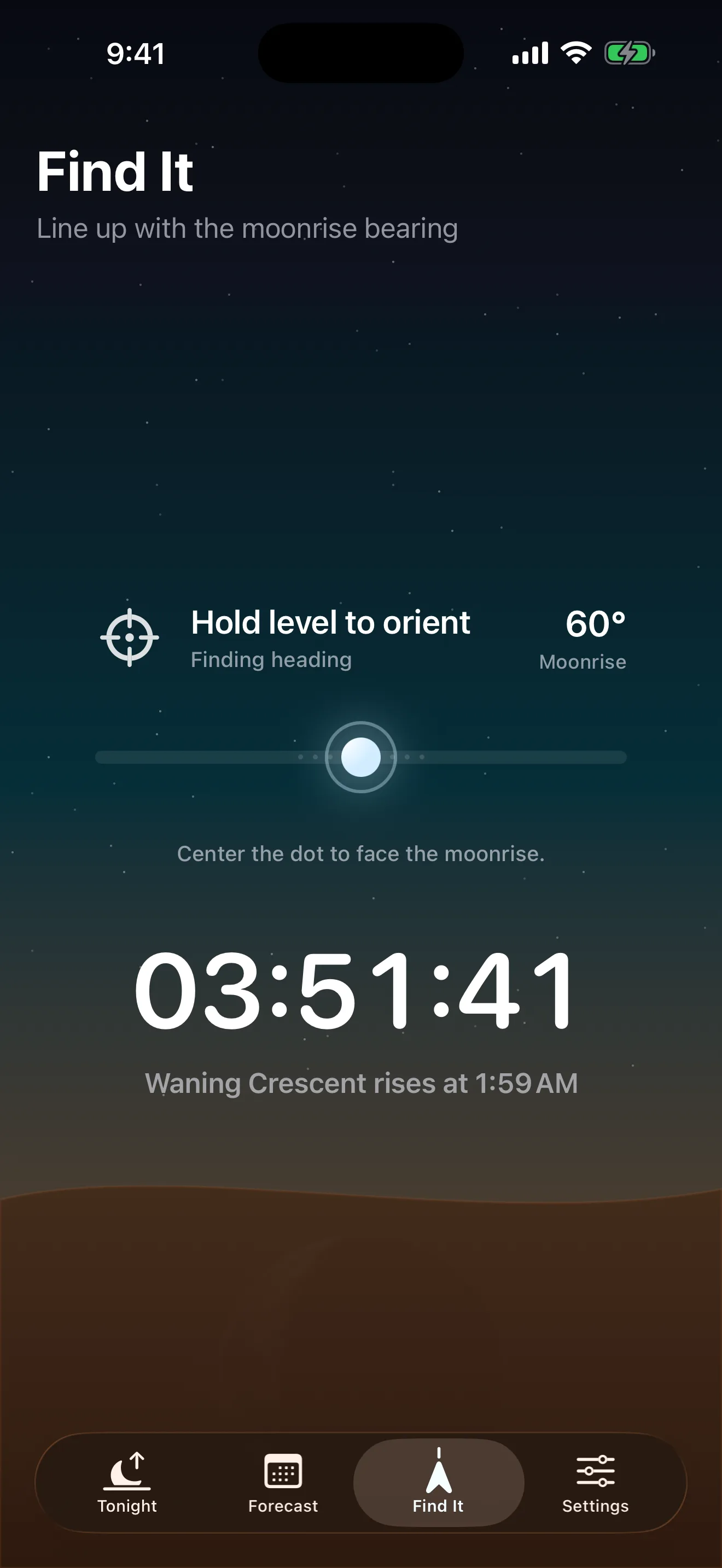
A last quarter Moon rises near midnight, is high around sunrise, and sets near midday. Waning crescents rise in the hours before dawn.
Why the Moon may rise before sunset
Moonrise is not limited to darkness. Waxing phases between first quarter and full often rise during the afternoon. Waning phases after full Moon may still be visible after sunrise. The blue daytime sky can make a low-contrast crescent or gibbous Moon harder to notice, but the Moon is still above the horizon.
The exact timing also shifts from one day to the next. NASA notes that the Moon rises about 50 minutes later per day on average because it moves eastward in its orbit while Earth rotates. That daily change is not perfectly constant, but it is a useful planning rule.
Sunset is only an approximation
The phrase “a full Moon rises at sunset” describes the geometry, not a promise that both events happen in the same minute. Local longitude, latitude, the Moon’s orbital position, elevation, atmospheric refraction, and terrain can all move the visible moment.
A ridge in the moonrise direction can delay the first visible edge even when the calculated astronomical rise has already happened. A high viewing location with a low horizon can make the Moon appear sooner. Low cloud or haze can hide it for longer.
A practical phase schedule
- New Moon: near sunrise
- Waxing crescent: morning to late morning
- First quarter: near midday
- Waxing gibbous: afternoon to early evening
- Full Moon: near sunset
- Waning gibbous: evening to late night
- Last quarter: near midnight
- Waning crescent: after midnight to before sunrise
Use these as broad windows. For an outing, check a location-specific time, the expected bearing, and the horizon in that direction.