Usually east, but not due east
Earth’s eastward rotation makes the Moon, Sun, planets, and stars appear to rise on the eastern side of the sky and set on the western side. But “east” covers a broad half of the horizon. The Moon rises exactly at 90 degrees azimuth only under particular geometry.
From one moonrise to the next, the point can shift north or south. Over longer cycles the range can be surprisingly wide.
Declination controls the bearing
The Moon’s orbit is tilted relative to Earth’s orbit, and Earth’s equator is tilted relative to that orbital plane. The Moon’s declination therefore changes rapidly through each month. For a Northern Hemisphere observer, a strongly northern Moon tends to rise north of east and follow a higher arc. A strongly southern Moon rises south of east and follows a lower arc. The pattern reverses in the Southern Hemisphere.
Latitude changes how that declination translates to the local horizon. Terrain and buildings can then alter the point of first visible appearance even when the geometric crossing is known.
Why direction matters
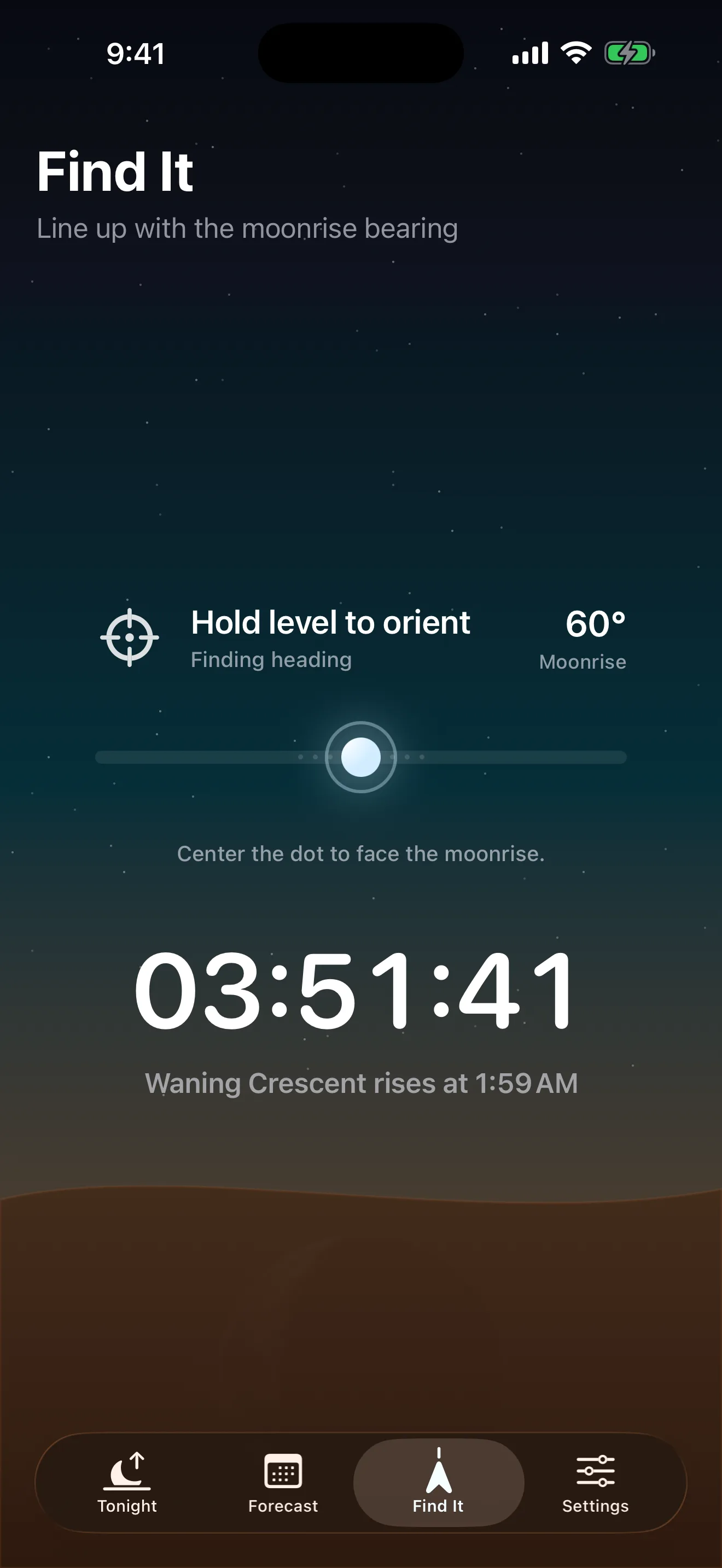
A compass bearing lets you choose a viewing location before the Moon appears. For photography, a difference of only a few degrees can move the Moon away from a planned building or peak. Use a local azimuth calculation for the exact date, then allow for horizon elevation and scout the line of sight in advance.